by Prof Jeremy Keenan
SUMMARY
This report (eight chapters) presents detailed evidence that Mali’s military junta with its Russian Africa Corps ally, previously called and still known as the Wagner group, has been perpetrating a genocide against the Tuareg population of northern Mali since November 2023.
Since 2012 Mali’s army, the Forces Armées Maliennes (FAMa), assisted by French military forces and a substantial UN peacekeeping force, had been fighting an incursion of Islamic terrorists. However, France’s failure to secure the country against the ‘terrorists’ resulted in Mali’s army seizing power in 2020. Following a second coup in 2021, the Moscow-aligned junta consolidated its power and invited the Russian mercenary Wagner group to replace the French. The 15,000 UN peacekeeping force was also told to leave the country.
Even before the Wagner group’s arrival, the FAMa had been committing atrocities against its civilian population for much of the previous decade. With the arrival of the Wagner group, these crimes against humanity proliferated, reaching international attention with the massacre of over 500 civilians in the village of Moura in March 2022.
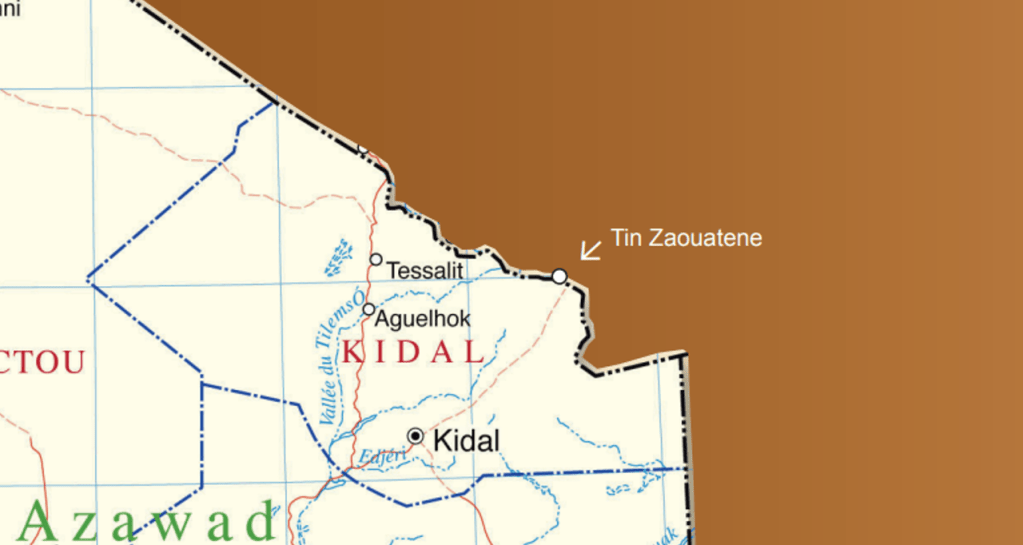
Despite the West’s portrayal of Mali as a successful, ethnically diverse democracy, there has been tension between successive Mali governments and the minority Tuareg population of northern Mali, known by the Tuareg as ‘Azawad’, since independence in 1960 (Chapter 1). Tuareg protests against their perceived political marginalisation and ethnic discrimination resulted in the most recent of several rebellions in 2012. A declaration of Azawad independence was cut short by Islamic terrorists taking over the rebellion, supported by Algeria’s secret services. This left the Tuareg separatists confined to their traditional stronghold of northern Mali’s Kidal region.
Three years later (2015), an Algerian negotiated Peace Agreement brought a degree of autonomy to northern Mali’s regions, especially that of Kidal, where the French and UN forces kept an uneasy peace through an effective buffer zone around Kidal.
The junta’s eviction of the French and UN forces on the grounds that they had failed to protect Mali from the Islamic terrorists provided the junta with the pretext of attacking Kidal on the grounds of reclaiming Malian national territory. To legitimise the attack, the junta falsely portrayed the Tuareg as ‘terrorists’.
On 2 October 2023, a FAMa-Wagner convoy set out from Gao to reclaim Kidal (Chapter 3), a 300 km journey that would normally take two days, but which took six weeks. The delay appears to have been deliberate, with the convoy spending days massacring civilians and their livestock along the way in the most barbaric manner: decapitation and impalement of the heads on poles or leaving them on the bodies, booby-trapped with explosives; disembowelments; incineration; torture, rape and all manner of bestiality. By the time the convoy reached Kidal, photographs of its atrocities had proceeded it on social media. The Wagner tactic of terrorising the civilian population had worked: by the time the convoy reached Kidal, faced with only light resistance, much of the population had fled to neighbouring countries.
The military convoy took Kidal in mid-November, raising the Wagner flag over the town and with the junta installing its own selected regional governor. In January, the junta formally announced its unilateral cancellation of the Algiers Peace Agreement.
With Kidal reclaimed, the convoy’s objective had been achieved. From then on, the FAMa-Wagner duo, in accordance with the definition of the United Nations’ Convention on the Prevention and Punishment of the Crime of Genocide (Chapter 2), to which Mali is a signatory, turned to the perpetration of a genocide against those Tuareg – now branded as ‘terrorists’ – who had not fled the region and who the FAMa-Wagner soldiers began hunting down in the surrounding semi-nomadic camps, settlements and villages.
The UN’s Genocide Convention defines genocide as any of five acts committed with the intent to destroy, in whole or in part, a national, ethnic, racial or religious group. At least three of these five acts, namely: killing members of the group; causing serious bodily or mental harm to members of the group, and deliberately inflicting on the group conditions of life calculated to bring about its physical destruction, have been committed by the FAMa-Wagner duo in the most brutal and barbaric ways since late 2023.
A detailed timeline of the genocidal acts committed by the FAMa-Wagner duo between late November 2023 and September-October 2024 is given in Chapter 4. (Note that October does not mark the end of the genocide). Along with Chapter 5, the Report, based on eye-witness accounts provided by local Tuareg civil society organisations, such as Kal Akal, and their representatives, describes, documents and dates the massacres, destruction of settlements and infrastructures (e.g. schools, water towers, wells, etc.), beheadings, impalements, looting, theft, torture, rapes, acts of cannibalism, incineration and booby-trapping of bodies and disappearances that have constituted this genocide.
For the perpetrators of these acts to be guilty of genocide, there must be “proof of intent.” Chapter 6 provides detailed documentary evidence to show that Mali governments over the last two decades have adopted what they and the US State Department called a “Tuareg First” policy. This meant that the Mali government would deal first with the Tuareg before Al Qaeda terrorists. Further proof of intent is demonstrated by Tuareg belonging to militia and political organisations that support and fight alongside the FAMa also being killed, simply because they were Tuareg.
By the end of September 2024, Kal Akal reckoned that about 800 civilians had been killed by the FAMa-Wagner duo but is certain that this number will rise. This number of deaths is not many in comparison to those killed in the Gaza genocide, Ukraine and Sudan, but in such a small, semi-nomadic and close-knit desert community, where survival sometimes appears as miraculous, even a handful of deaths is catastrophic.
Further evidence of Mali’s intended genocide comes from reports – compiled by Akli Sh’kka after his investigations into the 1 December drone attacks on Tin Zaouatene -that captured Russian soldiers being held as prisoners by FLA fighters in northeast Mali have confessed that they, along with the FAMa, were ordered by Mali’s coup leader and interim President, Colonel (now Général d’Armée) Assimi Goïta, to kill all ‘white-skinned’ inhabitants of the Kidal region.
This Report provides the evidence that obligates the international community to investigate and take action to stop this genocide and bring its perpetrators
to justice.
October 2024

