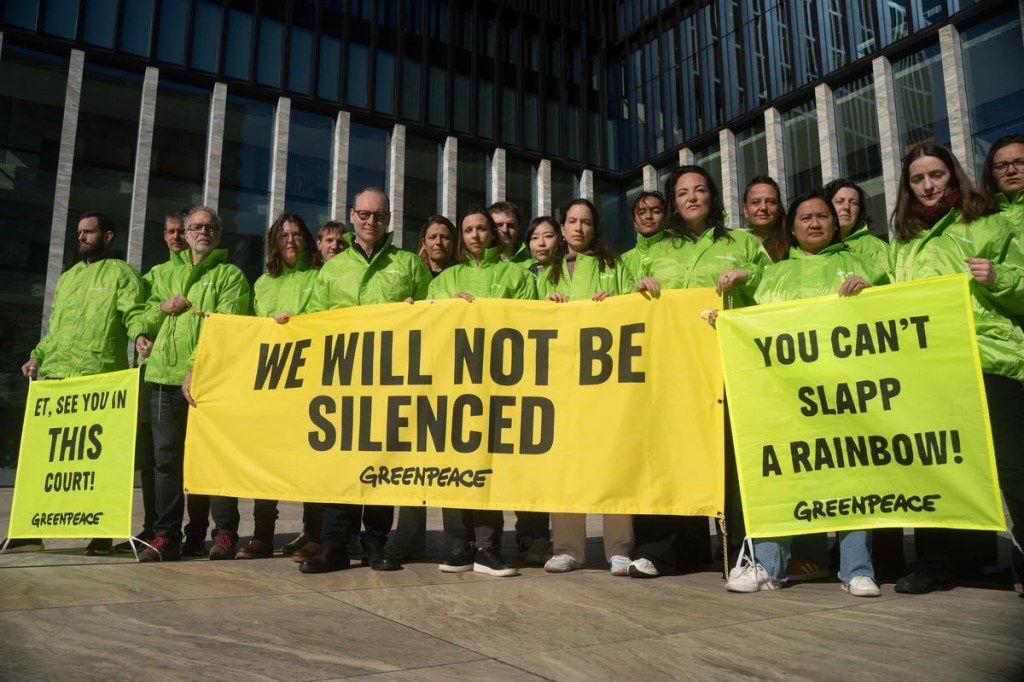
How Big Oil’s latest legal attack on Greenpeace is putting the future of climate activism at risk
by Gwen Jones
Energy Transfer LP’s recent case against Greenpeace illustrates, in no uncertain terms, the severity of the threat posed to civil society by predatory litigation. The oil giant’s victory not only threatens the survival of Greenpeace itself, but sets a precedent which throws the future of public participation in general into jeopardy. This post opens with a discussion of this latest case and outlines the nature of ‘SLAPPs’. It then examines several of Greenpeace’s prior legal battles, and explores what may separate this case, and another of its losses, from its victories: namely, the absence of effective anti-SLAPP legislation. I discuss the inadequacies of state anti-SLAPP law, and make a case for its introduction at federal level. I then explore how likely – or unlikely – the introduction of such legislation may be under the current administration, and finally, how it may be possible for other countries to take action.
On the 19th March 2025, Greenpeace announced that it had been found liable for over US$660 million in damages to American fossil fuel giant Energy Transfer. A Morton County jury found three separate Greenpeace entities – Greenpeace Inc., Greenpeace Fund and Greenpeace International – liable on a host of charges, including trespass, aiding and abetting trespass, defamation and tortious interference with business. The lawsuit is the culmination of a near-decade long legal battle, initiated in response to peaceful protest actions conducted by Greenpeace against the construction of the Dakota Access Pipeline (DAPL) in 2016. Such a large sum threatens to bankrupt Greenpeace entirely.
SLAPPs
Greenpeace, alongside a host of other civil society groups, have denounced Energy Transfer’s suit as a SLAPP – or Strategic Lawsuit Against Public Participation. SLAPPs are abusive or predatory lawsuits intended to deter or stifle criticism, and are often filed by large corporations against journalists, whistleblowers or activist groups. While not illegal, SLAPPs by definition involve a misuse of the legal system – the filing of unmeritorious suits or the leveraging of abusive legal tactics – to intimidate or financially exhaust opponents. They are designed to have a chilling effect on public participation generally, and are detrimental to freedoms of speech, press and protest. The outcome of the Energy Transfer vs Greenpeace case therefore sets a troubling precedent – that predatory legal action of this kind can and does pay.
The verdict is ‘not only an attack on Greenpeace – it is a chilling assault on the entire climate movement,’ said Anne Jellema, executive director of advocacy group 350.org. ‘It sends a dangerous message: that fossil fuel giants can weaponise the courts to bankrupt and silence those who challenge the destruction of our planet.’
Greenpeace’s legal battles
This is not the first time Greenpeace has been the target of legal action. In 2013, Resolute Forest Products, a Canadian pulp and paper company, sued Greenpeace for defamation and tortious interference under the RICO act – legislation originally drafted to tackle organized crime – in response to the latter’s ‘Forest Destroyer’ campaign. An appeal was granted to transfer the case from Georgia to California federal court, where all claims against Greenpeace were dismissed. Resolute Forest Products was ordered to pay US$800,000 in legal fees.
In 2023, French oil giant TotalEnergies sued Greenpeace France for allegedly ‘disseminating false or misleading information regarding its carbon footprint’. The case was dismissed in March 2024 by the Paris Judicial Court, finding the summons ‘too vague’. Another win for Greenpeace came later the same year: Shell and platform builder Fluor filed a SLAPP against Greenpeace UK claiming ‘tort of unlawful means conspiracy’, after nine activists boarded a floating oil platform and occupied it for 13 days. The suit would have seen Greenpeace facing over US$11 million in damages but was settled out of court in December 2024, with Greenpeace accepting no liability and making no payments to Shell, instead pledging to donate US$300,000 to the Royal National Lifeboat Institution.
The most recent case stands out in its finding against Greenpeace. The organisation’s only other notable loss in recent years came in 2015, when Shell successfully obtained a preliminary injunction preventing Greenpeace from interfering with three vessels during its Arctic drilling season in Alaska. A motion by Greenpeace to dismiss the suit was denied by the District of Alaska federal district court.
Anti-SLAPP laws and their power to protect
Of course, many factors separate these cases from each other, with outcomes hinging on several things from the strength of each case to the response from civil society itself, including the degree of public opposition.
There is, however, one notable deciding factor in at least one of Greenpeace’s legal victories: the presence of strong anti-SLAPP legislation. Anti-SLAPP laws seek to protect actors against SLAPPs through provisions allowing respondents to strike down cases that can be shown to be meritless or abusive, as well as potentially requiring claimants to cover all legal costs in cases dismissed on these grounds. The latter in particular is intended to deter SLAPPs, as well protecting respondents from the heavy financial losses they may incur over the course of the legal process.
In the Resolute Forest case, Greenpeace’s motion to transfer the case to California was likely influenced by the presence of robust anti-SLAPP legislation in the state, among the strongest in the country. Indeed, Greenpeace’s motion to strike the case was filed pursuant to California’s anti-SLAPP statute, and granted by California federal court on the basis of these laws.
By contrast, Greenpeace’s two most notable losses – Energy Transfer’s most recent suit, as well as Shell’s successful 2015 injunction – both occurred in jurisdictions with no such protections. Both Alaska and North Dakota, where Energy Transfer’s case was filed, are two among the 15 US states with no anti-SLAPP legislation in place. The absence of such safeguards leaves actors like Greenpeace vulnerable to these kinds of lawsuits. It is highly unlikely that the most recent case would have ever even reached a jury had it been filed in, say, California.
The future of climate activism, and indeed of activism generally, will therefore likely have much to do with the presence – or absence – of this sort of protective legislation. This is especially true following Energy Transfer’s recent victory. While SLAPPs are already commonplace in the US, the outcome of this case may act as a spur for further action of this nature.
US Anti-SLAPP law – the problem with states
So where does US anti-SLAPP legislation stand today? As of January 2025, 35 states have adopted some form of anti-SLAPP law. These vary in strength and breadth of provision, the gold standard being UPEPA – the Uniform Public Expression Protection Act – a model law drafted by the Uniform Law Commission designed to protect rights of speech, press, assembly, petition and association on any ‘matter of public concern’. Versions of UPEPA have so far been adopted by 11 states.
As noted however, there remains a sizeable minority of states – 15 – in which no anti-SLAPP provisions exist. Others still are limited in scope, concerning only narrow ranges of speech, or lacking the procedural safeguards to make them effective. This is a major problem; inconsistent protections allow ample scope for forum-shopping, whereby claimants will seek grounds on which to file in jurisdictions with no or limited anti-SLAPP laws. Worse still is the fact that federal courts across the US disagree on whether state anti-SLAPP laws can apply in federal court (a decision which hinges on their being considered procedural or substantive). This means that in cases involving diversity jurisdiction (in which parties are based in different states), respondents may be prevented from invoking state protections, depending on the position of the federal court hearing the case – both Second and Fifth Circuit federal courts, for instance, do not apply state anti-SLAPP statutes. This creates yet further scope for forum shopping, and introduces loopholes for claimants to avoid anti-SLAPP laws even in otherwise well-protected states. Finally, state laws provide no protection against federal claims.
For all of these reasons, existing state laws are not enough to adequately protect against the threat of SLAPPs, as the Energy Transfer v Greenpeace case makes troublingly clear. However, there is a fairly simple solution: the introduction of a robust anti-SLAPP statute at federal level. Federal anti-SLAPP laws would clamp down on forum shopping opportunities, protect respondents across all cases heard in federal courts, and from federal claims.
Towards a federal law?
But how far are we from this kind of legislation? In December of last year, representatives introduced a bipartisan bill intended to stop this very gap. The bill, titled the Free Speech Protection Act (FSPA), sought to enshrine many of the provisions contained in UPEPA into federal law. Had it passed, the legislation would have granted respondents the ability to file special motions to dismiss any lawsuits that could reasonably be classified as SLAPPs, as well as claiming compensation for legal fees. This received widespread support from a diverse array of civil society organisations, including Greenpeace. Unfortunately, the bill never made it passed the committee stage, and died at the end of the last Congress. Rep. Raskin, one of the bill’s main sponsors, also tried and failed to introduce similar legislation in 2022.
Of course, there remains the option that the bill, or something like it, could be reintroduced during this Congressional session. The chances of it succeeding this time, though, are considerably slimmer than before. Trump’s return to the Whitehouse is bad news for any future efforts in this domain – the President himself has a long history of initiating unmeritorious legal action against critics, including several recent cases brought against ABC, CBS, the Des Moines Register, and Ann Selzer, an Iowa pollster. He has also made clear the purpose of these suits – of a defamation lawsuit brought against Timothy O’Brien, author of TrumpNation: The Art of Being Donald, Trump said: ‘I spent a couple of bucks on legal fees, and they spent a whole lot more. I did it to make his life miserable, which I’m happy about.’ Trump’s recent attacks on major US law firms, which seek to stifle firms’ abilities to represent clients in cases brought against the federal government, are a further indictment of the President’s attitudes toward the impartiality of law. Elon Musk has a similar history, having sued both Media Matters and the Centre for Countering Digital Hate for their reporting on hate speech on X – two suits which have also been widely regarded as SLAPPs.
It seems unlikely then, that the President would take kindly to the introduction of a federal anti-SLAPP statute, or that a compliant Republican-controlled Congress would enable its passage. The situation is unlikely to change in the foreseeable future, although possibly depending on the outcome of the next Congressional elections. Until then, activists groups like Greenpeace remain at considerable risk of predatory litigation.
Hope from elsewhere – Greenpeace and the EU anti-SLAPP Directive
Hope may come, though, from outside the US. In February of this year, with Energy Transfer’s case still ongoing, Greenpeace filed a countersuit seeking reparations for the damages inflicted by the years-long legal battle. Headquartered in Amsterdam, Greenpeace International filed its suit in Dutch court, citing both Dutch law and Chapter V of the new EU Anti-SLAPP Directive, in what is set to be the first major test of this legislation. The Directive seeks to protect EU-domiciled entities – like Greenpeace International – from ‘manifestly unfounded claims or abusive court proceedings against public participation in third-countries’. Once implemented, member states will be prevented from recognising or enforcing any third-country rulings in cases that meet these criteria. It also contains a provision entitling respondents to ‘efficient remedy available in the Union’, for legal fees and other damages incurred during legal proceedings. Although all member states have until 2026 to translate the Directive into national law, the Dutch government has stated that Dutch law should already be interpreted as substantiating Chapter V.
Greenpeace is hoping that the EU Directive will offer protection for the assets it holds within the EU. It is not clear, however, that any protection can be provided for its US assets, meaning that both Greenpeace Inc and Greenpeace Fund – both US-based entities – are still at risk. Equally, there is no compulsion for third-party courts to carry out EU judgements – meaning Energy Transfer’s US assets are also likely safe from any remedies that Greenpeace is awarded in European court (although its European subsidiary, Sunoco LP, may not be). Regardless, a favourable EU ruling under the new Directive might still mean the difference between Greenpeace’s bankruptcy and survival.
The Directive is not perfect – it has several shortcomings which, while having little bearing on the Greenpeace case, may pose challenges to others in future. It excludes, for example, criminal cases, which is problematic given that defamation and insult remain subject to criminal charges in many countries around the world, including several member states. Article 17 allows respondents to claim damages only after a case is concluded, as opposed to while it remains ongoing – this reduces some of the power to deter SLAPPs which this provision may otherwise have had, though Greenpeace has been able to get around this via recourse to Dutch national law. Forum shopping within the EU is also still possible under the new legislation – claimants in tort proceedings are entitled to choose either the respondent’s domicile or the state in which the harm was caused in which to bring a case. Different member states have significantly different rules regarding, for example, defamation, with claimants thus being incentivised to file in the state where laws are strongest and farthest reaching. In suits involving online publications, for example, it may be argued that ‘harm’ has occurred in any jurisdiction in which the material has been viewed. This grants claimants a huge amount of discretion.
The future is open
These are gaps which should be plugged. Nevertheless, a successful test of this new legislation should send a clear message – that while the future of anti-SLAPP law in the US remains uncertain, other countries must step their own protections up. The Energy Transfer v Greenpeace case is not unique in its transnational character – many SLAPPs are filed across borders. To protect activism, journalism and whistle blowing from these kind of threats, robust legal frameworks which explicitly recognise the risks posed by third-country judgements, and directly seek to counter them, will be essential. A world in which these institutions can no longer function – where civil society has been choked off, and state and market are left to operate unchecked – is a reality we should all be desperately keen to avoid. Without the protections offered by civil society – whether through oversight, awareness-building, or other forms of resistance – both civil and human rights are significantly more vulnerable to encroachment and abuse.
The EU Directive may thus provide a blueprint to build on and strengthen. The existential threat from the case against Greenpeace should be all the proof we need of the threat that SLAPPs pose to activism, and the critical importance of civil society’s role in resisting state crime.

